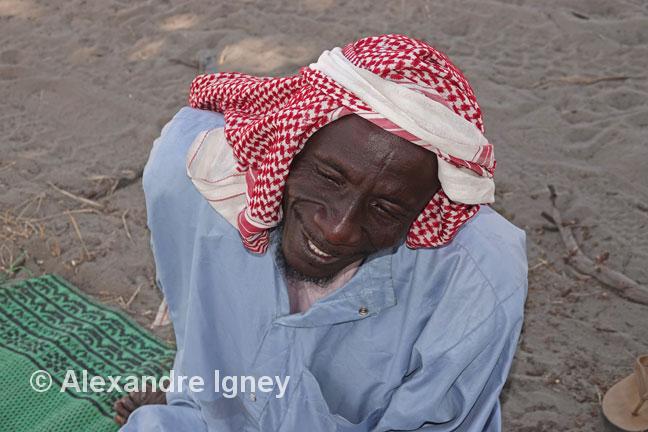
Kouloudia, Lake Chad, Chad, October 2023.
Sitting under a bushy palm tree in the Lake Chad southern shore, Hassan Adam, a 52-year-old Buduma nomad, asks us: “Can I go to your country by walking?” In a straight line it’s 5,000 kilometers to the border of the European Union, passing through the deserts of Libya and Egypt, the Middle East, and Turkey. Skirting the dangerous Mediterranean but passing through the even more dangerous occupied and invaded Palestine.
Assis sous un palmier touffu dans la région du lac Tchad, Hassan Adam, un nomade Boudouma de 52 ans, nous demande: “Est-ce que je peux aller dans votre pays en marchant?” En ligne droite cela fait 5.000 kilomètres jusqu’à la frontière de l’Union européenne, en passant par les déserts de Libye et d’Egypte, le Moyen-Orient, et la Turquie. Contournant la dangereuse Méditerranée mais passant par l’encore plus dangereuse Palestine occupée et envahie.
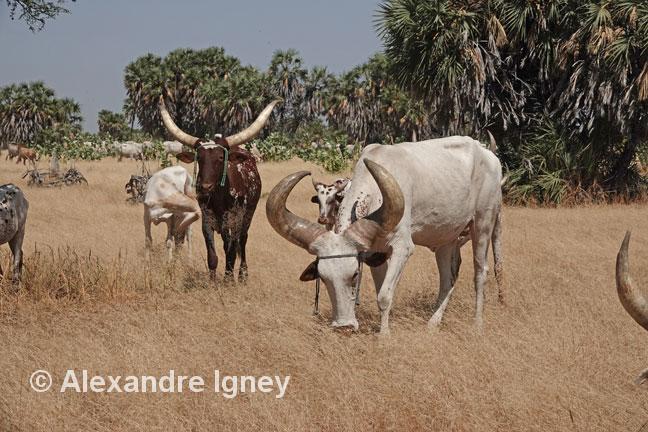
Kouloudia, Lake Chad, Chad, October 2023. The Kouri cows sport huge horns and live only around Lake Chad. Les vaches Kouri arborent d’énormes cornes et vivent uniquement autour du lac Tchad.
Next to Hassan Adam sits Adam Moussa, the leader of the clan. He has mats spread out to receive us on the scrubby sand. And he serves us milk in a plastic bowl (fresh, unpasteurized) from Kouri, the cows that only live around Lake Chad. At 51, he has two wives, like the majority of Chadians, one divorced and one deceased. And then two more wives, with 11 children in total, a minimum in this country. A 40-year-old taxi driver had told us: “I have six children but I’m not finished.”
“Why do you have so many children?”
“We need them to herd and work in agriculture” – they sow corn, beans and the omnipresent millet. The women wash and cook, and take care of the little ones. While we talk with the notables, a group of men sit on mats under another tree and chat. Women come and go around the most rudimentary huts made of plastic canvas and branches. Little girls throw stones to make palm seeds fall.
A côté d’Hassan Adam est assis Adam Moussa, le chef du clan. Il a fait étendre des tapis pour nous recevoir sur le sable broussailleux. Et il nous sert dans un bol en plastique du lait (tout frais, non pasteurisé) de Kouri, les vaches qui ne vivent qu’autour du lac Tchad. À 51 ans, il a eu deux épouses, comme la majorité des Tchadiens, une divorcée et une défunte. Et ensuite deux autres épouses, avec 11 enfants au total, un minimum dans ce pays. Un chauffeur de taxi de 40 ans nous avait dit: “J’ai six enfants mais je n’ai pas fini”.
“Pourquoi avez-vous tant d’enfants?”
“On en a besoin pour garder les troupeaux et travailler dans l’agriculture” – ils sèment du maïs, des haricots et l’omniprésent mil. Les femmes, elles, lavent et cuisinent, et s’occupent des tout-petits. Pendant que nous conversons avec les notables, un groupe d’hommes est assis sur des nattes sous un autre arbre et bavarde. Des femmes vont et viennent autour de huttes des plus rudimentaires faites de toiles en plastique et de branchages. Des fillettes lancent des pierres pour faire tomber des graines de palmier.
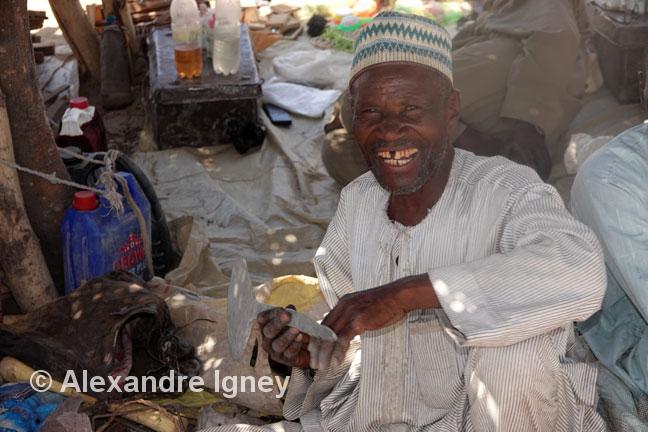
Isseirom, Lake Chad, Chad, October 2023. Buduma seller at the big Friday market of this town. Vendeur boudouma au grand marché du vendredi de cette bourgade.
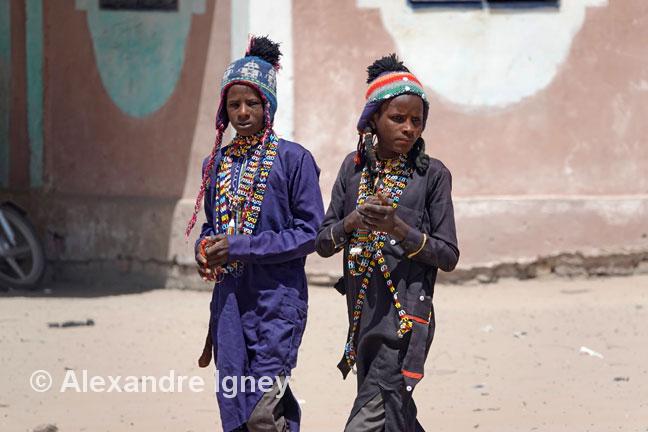
Isseirom, Lake Chad, Chad, October 2023. Fulanis, easily recognizable by their clothes, come to buy supplies at the big Friday market. Des Peuls, facilement reconnaissables à leurs habits, viennent s’approvisionner au grand marché du vendredi.
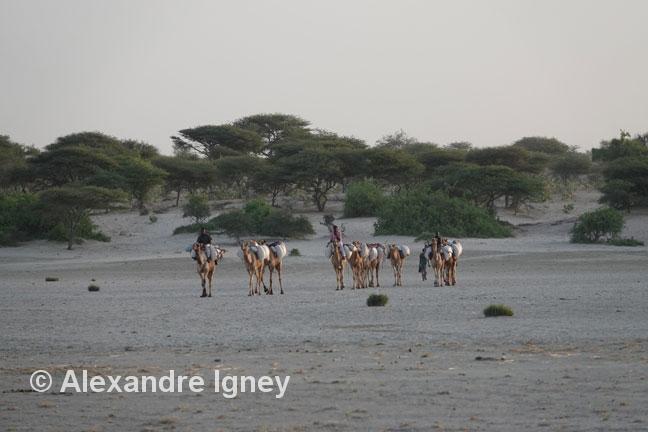
Doum Doum, Lake Chad, Chad, October 2023. A salt caravan on its way to the big Friday market at Isseirom. Une caravane de sel en route vers le grand marché du vendredi à Isseirom.
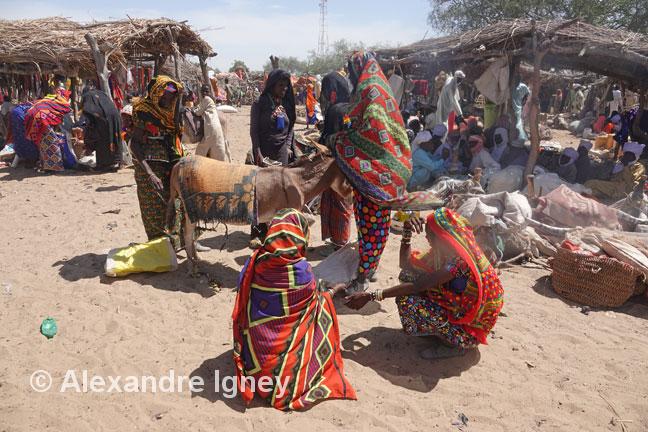
Isseirom, Lake Chad, Chad, October 2023. Buduma women at the big Friday market on the shores of Lake Chad. Femmes boudouma au grand marché du vendredi sur les rives du lac Tchad.
The Budumas are only one of the 200 ethnic groups in Chad! They populate the surroundings of Lake Chad and are part of the Kanembou who come from the great, thousand-year-old Kanem and Bornu empires which lasted from the 8th to the 19th century in the center of the country, extending to neighboring countries. Together, the Kanembou and Buduma – former enemies – represent almost 10% of Chad’s population. The Fulani also inhabit this region.
Les Boudoumas ne sont qu’une des 200 ethnies du Tchad ! Ils peuplent les abords du lac Tchad et font partie des Kanembou qui proviennent des grands et millénaires empires Kanem et Bornu qui ont duré du 8ème au 19ème siècle au centre du pays et qui s’étendaient aux pays voisins. Ensemble, les Kanembou et Boudouma – anciens ennemis – représentent près de 10% de la population du Tchad. Les Peuls aussi habitent cette région.
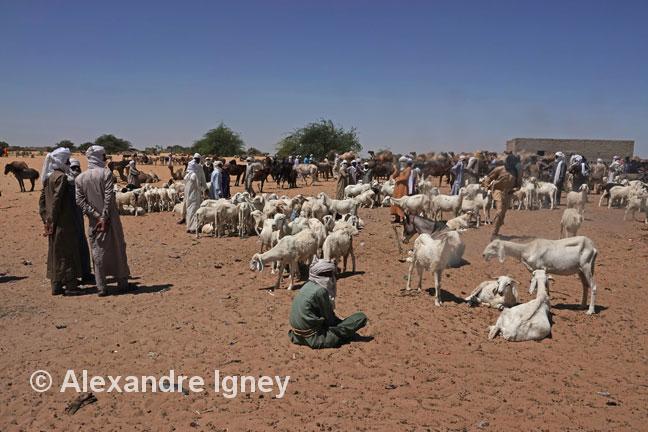
Isseirom, Lake Chad, Chad, October 2023. The livestock part of the big Friday market on the shores of the former largest lake in the world, at the meeting point of the great Trans-African and Trans-Saharan Highways. La partie bétail du grand marché du vendredi sur les rives de l’ex-plus grand lac au monde, au point de rencontre des grandes Autoroutes transafricaine et transsaharienne.
The surface area of Lake Chad has decreased enormously as explained by the Chadian Hindou Oumarou Ibrahim, founder of the Association of Fulani Women and Indigenous Peoples of Chad (AFPAT): “When my mother was born, Lake Chad used to be about 25,000 kilometers square of water. When I was born, 30 years ago [1989], it was 10,000 square kilometers. And actually, now [2019], it’s about 1,200 square kilometers of water.”
And what can we say further into our Holocene era, some 7,000 years ago, when the so-called Mega-Lake Chad covered… 400,000 km2, larger than the Caspian Sea! Thanks to satellites we can see its ancient shores hundreds of kilometers north of the current lake. We would like to believe that it was on such an ancient bank, in the Mourdi depression of the Ennedi, some 900 kilometers from the northeast, that one of our jeeps almost overturned about twenty meters below; the dazzling sun on a crescent-shaped orange sand dune makes it difficult to see the steep drop. No wonder we find shells in Mourdi.
But these differences in altitude can go back much, much, much further in time, to the time of the Karoo glaciation (Late Paleozoic Ice Age), that is to say 360 to 255 million years ago when large terrestrial ice caps were present on the surface of the Earth, notably in the Ennedi. At the time of the Gondwana continent when Africa and Europe were united, the Ennedi cap probably reached the Tethys Ocean around the 40th parallel south! (Ennedi is currently around the 17th parallel north). Some of these caps are now covered in sand, but visible by new techniques for analyzing satellite image data.
Coming back to Lake Chad, it must nevertheless be noted that the great loss of modern times took place between the 1960s and 1990s, when it went from 25,000 km2 to less than 2,000. Since then the level has not only stabilized but has recovered a good part, standing today (2024) around 14,000 km2. There is a lot of media coverage about the drying up of Lake Chad because there are big interests at stake, starting with the private companies which are at the base of a project, the Transaqua inter-basin water transfer (IBWT) by the Italian Bonefica which should bring water from the Congo River through a 2,400 kilometer long canal! This project dates from the 1970s, remained a dead letter then came back to life more recently and a contract was signed in 2017 with the company PowerChina, China investing very heavily in the African continent, particularly infrastructure. Driving the charette are local politicians who are aiming for financial windfall from a project estimated at 50 billion US dollars, and undoubtedly more.
On the other hand, such a mega-project would help to open up not only Chad, but the entire continent, the canal connecting to two major roads, the Trans-African Highway 8, Lagos-Mombasa which connects the Indian and Atlantic Oceans, and the Lagos-Algiers trans-Saharan highway which connects the Gulf of Guinea and the Mediterranean. [continue to the South or the Ennedi desert]
La superficie du lac Tchad a énormément diminué ainsi qu’exposé par la Tchadienne Hindou Oumarou Ibrahim, fondatrice de Association des Femmes Peules et Peuples Autochtones du Tchad (AFPAT): “Lorsque ma mère est née, le lac Tchad s’étendait sur environ 25.000 kilomètres carrés d’eau. Quand je suis née, il y a 30 ans [1989], c’était 10.000 kilomètres carrés. Et en fait, maintenant [2019], cela représente environ 1.200 kilomètres carrés d’eau”.
Et que dire de plus en avant dans notre époque holocène, soit il y a quelque 7.000 ans, quand le dénommé Méga-Lac Tchad couvrait… 400.000 km2, plus grand que la mer Caspienne! Grâce aux satellites on peut voir ses anciennes rives à des centaines de kilomètres au nord du lac actuel. Nous aimerions croire que c’est sur une telle ancienne rive, dans la dépression Mourdi de l’Ennedi, à quelques 900 kilomètres du nord-est, qu’une de nos jeeps a failli se renverser une vingtaine de mètres plus bas; le soleil éblouissant sur une dune barkhane de sable orange en forme de croissant permet difficilement de voir le fort dénivelé. Pas étonnant qu’on trouve des coquillages dans le Mourdi.
Mais ces dénivelés peuvent remonter beaucoup, beaucoup, beaucoup plus loin dans le temps, à l’époque de la glaciation du Karoo (Late Paleozoic Ice Age), soit il y a de 360 à 255 millions d’années quand de grandes calottes glaciaires terrestres étaient présentes à la surface de la Terre, notamment dans l’Ennedi. À l’époque du continent Gondwana quand l’Afrique et l’Europe étaient unies, la calotte de l’Ennedi atteignant probablement l’océan Téthys aux environs du 40ème parallèle sud! (L’Ennedi est actuellement autour du 17ème parallèle nord). Certaines de ces calottes sont maintenant recouvertes de sable, mais visibles par les nouvelles techniques d’analyse des données d’images de satellites.
Pour en revenir au lac Tchad, il faut néanmoins préciser que la grande perte des temps modernes a eu lieu entre les années 1960 et 1990, quand il est passé de 25.000 km2 à moins de 2.000. Depuis lors le niveau s’est non seulement stabilisé mais a récupéré une bonne partie, se situant aujourd’hui (2024) autour de 14.000 km2 . On médiatise beaucoup l’assèchement du lac Tchad car il y a de gros intérêts en jeu, à commencer par les entreprises privées qui sont à la base d’un projet, le Transaqua inter-basin water transfer (IBWT) par l’italienne Bonefica qui devrait amener de l’eau du fleuve Congo par un canal long de 2.400 kilomètres! Ce projet date des années 1970, est resté lettre morte puis a repris vie plus récemment et un contrat a été signé en 2017 avec la compagnie PowerChina, la Chine investissant très fort dans le continent africain, en particulier l’infrastructure. Poussant à la charette il y a les politiques locaux qui visent la manne financière d’un projet estimé à 50 milliards de dollars étatsuniens, et sans doute plus.
D’un autre côté un tel méga-projet contribuerait à désenclaver non seulement le Tchad, mais tout le continent, le canal se connectant à deux grands axes routiers, l’Autoroute transafricaine 8, Lagos-Mombasa qui relie les océans Indien et Atlantique, et l’autoroute transsaharienne Lagos-Alger qui relie le golfe de Guinée et la Méditerranée. [continuez vers le Sud ou le désert de l’Ennedi]